Directions Vocabulary for Beginners
Build essential everyday English to understand and give simple directions. Designed for beginners (A1–A2), this course introduces key words and phrases such as left, right, straight ahead, turn, go past, cross, at the corner, opposite, next to, between and near, plus common places around town (high street, station, post office, chemist, petrol station), road features (roundabout, zebra crossing, traffic lights) and compass points (north, south, east, west). You will learn useful question forms and imperatives for asking and giving directions, follow signs and simple maps, and check meaning with real-life dialogues. Interactive maps, audio, pronunciation practice, role-plays and quick quizzes help you memorise and use vocabulary with confidence. Ideal for travel, study and everyday life, with downloadable phrase banks and a final checklist to track your progress.

Instructor
Farhan Quraishi
- Description
- Curriculum
- FAQ
- Reviews
Vocabulary for Beginners: Directions
This lesson builds essential direction vocabulary to help you ask for, give, and understand simple routes in everyday situations in the UK. Use the words and phrases below to talk about where places are, how to get from A to B, and how to follow signs safely on streets, at junctions, and in stations.
Key direction words and phrases
- left / right – the two sides when you face forward.
- straight ahead – do not turn; keep going forward.
- turn left / turn right – change direction at a point.
- go past – continue until you pass a place or sign.
- go along – move forward on a road or street.
- across – from one side to the other side.
- at the corner – where two streets meet.
- junction / crossroads – where roads join; four-way meeting.
- roundabout – a circular junction; follow the exits.
- traffic lights – red, amber, green signals for cars and people.
- zebra crossing – black and white stripes for pedestrians.
- opposite – directly facing something across a space.
- next to – immediately beside; very close.
- between – in the middle of two places.
- behind / in front of – at the back / at the front.
- near / far – not far away / a long distance away.
- on the left/right-hand side – the side of the street or room.
- follow the signs – look at and obey direction signs.
- pavement – the path for people beside the road.
- car park – area to park cars.
- petrol station – place to buy fuel for cars.
- under / over – below / above something (a bridge, road).
- entrance / exit – way in / way out.
Useful questions
- Excuse me, how do I get to the station?
- Is there a bus stop near here?
- Which way is the city centre, please?
- How far is it on foot?
- Should I turn left or right at the lights?
- Can you show me on the map?
Giving simple directions
- Go straight ahead for two minutes, then turn right at the traffic lights.
- Go past the church and take the second left.
- At the roundabout, take the first exit.
- The museum is opposite the car park, next to the cafe.
- Walk along the pavement and cross at the zebra crossing.
Short dialogue
A: Excuse me, where is the library?
B: Go straight ahead and turn left at the corner.
A: Is it near the bus stop?
B: Yes, it is opposite the bus stop, between the bank and the cafe.
A: Thank you!
B: You are welcome.
Cardinal points (basic compass words)
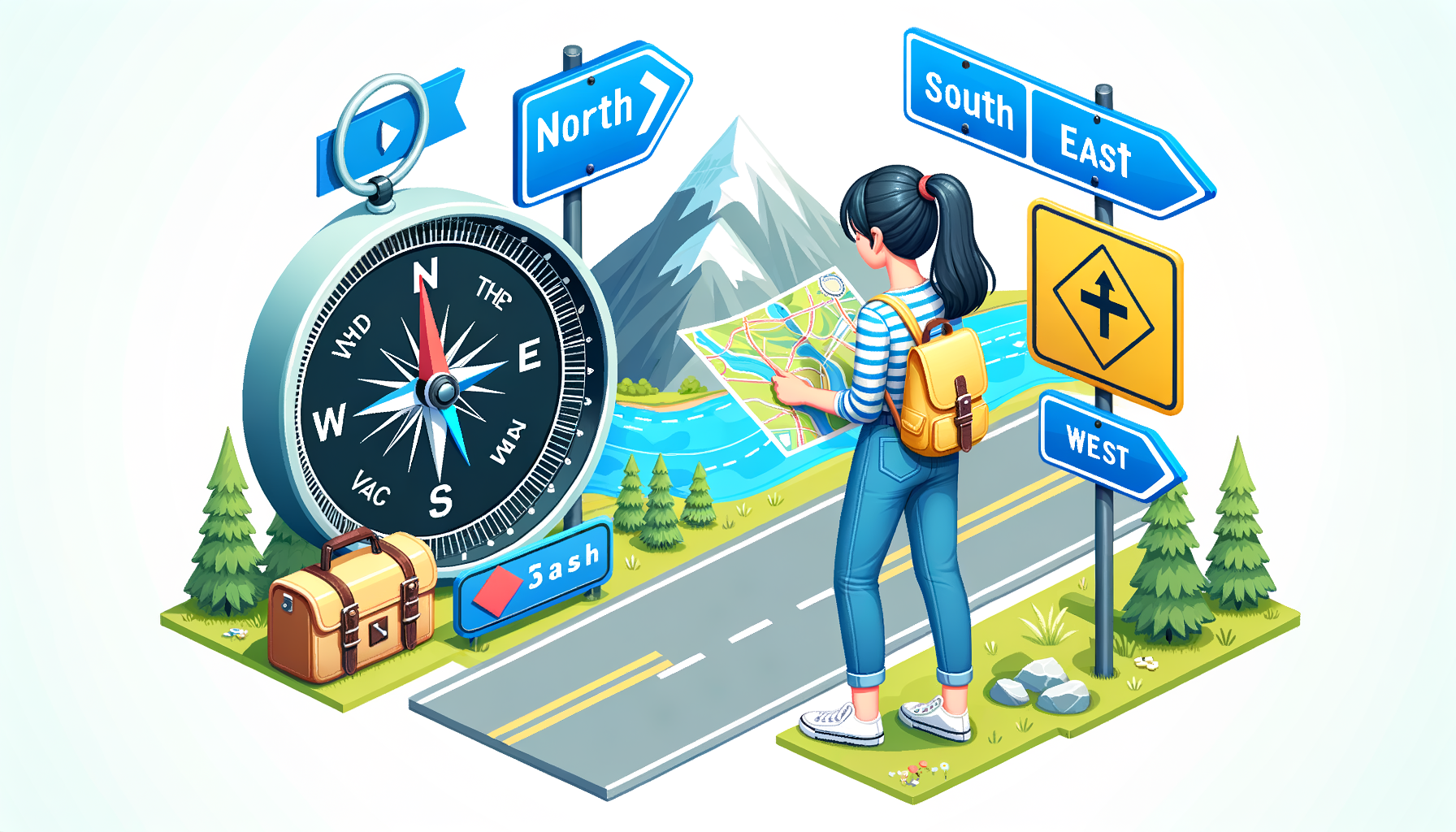
North, south, east, and west show general direction. For example: The river is east of the station. The park is to the north of the museum. Use these for maps and signs.
Tips and common mistakes
- Say turn left/right, not take left/right (say take the first left).
- Use go past for passing a place; do not say go by it.
- Opposite means facing you; next to means beside you.
- In the UK, cars drive on the left. Use zebra crossings.
- When unsure, ask: Could you repeat that, please?
Mini practice
- Write three steps from your home to a shop using go along, turn, and opposite.
- Look at a map and describe a route using first, then, and finally.
- Ask a partner for directions to a petrol station using two of the questions above.
Essential direction words and places
-
1
 Basic direction words: left, right, straight onLearn to understand and use the direction words left, right, and straight on to follow and give simple directions. Through interactive map and classroom tasks, you’ll practise asking for directions and guiding someone clearly and politely. By the end, you’ll be able to navigate basic routes and give short, accurate instructions.
 -
2
Prepositions for place: next to, opposite, betweenLearn how to use the prepositions next to, opposite, and between to describe where people and things are. Practise asking and answering “Where is/are...?” using pictures and simple maps, and give or follow basic directions. By the end, you’ll confidently choose the right preposition and build accurate sentences for everyday situations.
-
3
Common places in town for giving directionsIn this lesson, students will learn key vocabulary for common places around town (e.g., post office, chemist, petrol station, high street) and practise using prepositions and directional phrases such as next to, opposite, on the corner, go straight on, and take the first left/right. They will ask for and give directions politely, using simple maps and typical UK landmarks to build confidence navigating a British town.
-
4
Street features: junctions, roundabouts, traffic lights
-
5
Asking for directions politelyIn this lesson, you’ll learn to ask for directions politely using indirect questions and modal verbs (e.g., “Could you tell me…?”, “Would you mind…?”). You’ll build essential vocabulary for landmarks and prepositions of place, practise polite intonation and pronunciation, and learn how to clarify, respond, and thank someone appropriately in everyday UK contexts.
Giving directions and understanding signs
-
6
Giving directions: phrases and patternsMaster essential British English phrases and sentence patterns for asking for and giving directions clearly and politely. You’ll practise imperatives and question forms, prepositions of place and movement, and sequencing language (e.g., go straight ahead, turn left at the lights, past/along/across), then apply them in realistic map and role-play tasks. By the end, you’ll confidently navigate and guide others using common landmarks, roundabouts, and effective clarification checks.
-
7
Using landmarks, distances and order wordsLearn to give clear, step-by-step directions by using landmarks as reference points, expressing distances (e.g., a few metres or two kilometres), and sequencing with order words such as first, next, then and finally. You will build the language for movement and place (turn left/right, go past, opposite, between), practise asking for and checking directions, and apply your skills to simple maps and real-life scenarios.
-
8
Reading simple maps and road signsIn this lesson, students will learn to read simple maps by using keys, symbols, and compass points to follow and plan short routes. They will also recognise common UK road signs—warning, regulatory, and information—and explain their meanings to make safe, confident navigation choices in real-life situations.
-
9
Short dialogues for real-life situationsThis lesson helps you practise short, natural dialogues for everyday situations such as greetings, asking for information, shopping, ordering food, making plans, and solving small problems. You’ll learn essential phrases and functional language, with pronunciation and intonation tips, plus turn-taking and polite forms to sound confident and fluent. By the end, you’ll be able to select the right expressions and respond naturally in real-life conversations.
-
10
 Directions vocabulary review
What are the basic direction words I should learn?
Key words: left, right, straight ahead, back, turn, north, south, east, west. Examples: Turn left at the traffic lights. Go straight ahead for two minutes. The park is east of the river.
How can I ask for directions politely?
Start politely: Excuse me. Useful questions: How do I get to the station? Could you tell me the way to the post office? Where is the nearest bus stop? Is it far? Always thank the person: Thanks for your help.
Which prepositions describe location and position?
Helpful prepositions: next to, between, opposite, in front of, behind, near, far, at the corner, across from. Example: The chemist is opposite the library, next to the bank. The café is between two shops.
What common place and road words will help me follow directions?
Useful place and road words: street, road, junction, crossroads, roundabout, traffic lights, zebra crossing, pavement, bridge, tunnel, car park, station, post office, museum. Example: Cross at the zebra crossing, then turn right at the junction.
Please, login to leave a review
Course details
Lectures
9
Quizzes
1
Basic info
- Level: Beginner (A1)
- Topic: Everyday vocabulary for giving and understanding directions
- Estimated time: 60–90 minutes
- Format: Self-paced lessons with audio, visuals, and short quizzes
- Outcomes: Confidently recognise and use direction words and simple phrases in real-life situations
Course requirements
- Very basic English reading ability (A0–A1)
- Access to a device with audio playback (speakers or headphones)
- Stable internet connection for interactive activities
- Willingness to practise speaking aloud and repeat phrases
Intended audience
- Absolute beginners learning English (ESOL/EFL A1)
- Travellers and newcomers who need to ask for and follow directions
- Secondary school and adult learners who prefer practical, situational language
- Learners preparing for everyday communication in the UK or other English-speaking environments
Popular courses